Your brochure sells the house.This sells the move.
The local knowledge a good sales advisor takes two years to build, researched and
written down in four weeks. On the desk during a viewing, in the buyer's hands after it,
and ready for whoever covers the site next week.
Some housebuilders call it a site bible. Ours is the one you can hand to a customer.
sources cited across the two samples, every one dated
4
weeks from agreed brief to print-ready artwork
£2,000
fixed fee for one development, no VAT on top
One document, three jobs
It gets used long after the viewing.
01
On the desk, mid-viewing
“What are the schools actually like?” is the question every advisor gets and
nobody wants to answer from memory. This gives you the name, the current Ofsted position
and the date it was checked, on one page, without leaving the conversation.
02
In the buyer's hands, afterwards
The brochure goes in the recycling and the guide goes on the kitchen table. It is the
thing they show the person who did not come to the viewing, and the reason the second
visit starts warmer than the first.
03
On day one, when the site changes hands
Sales advisors move between sites. Cover starts on a Saturday with no handover. A new
advisor with this in front of them is useful on their first morning instead of their
third month, and the site does not lose momentum because someone left.
The third one is the reason clients renew. The first two sell homes; the third protects
the sale when your team changes.
01
Scope
02
Research
03
Write
04
Design
05
Amends
06
Print-ready
We scope it before we research it. That is the difference between a guide and a template.
The service
Researched on the ground. Sourced on the page.
Four weeks from brief to print-ready artwork, drawn to your brand guidelines, down to the
page shape.
01
Researched, not assembled
Council, Ofsted, NHS, rail operator and town sources, plus a day walking the place.
Club meeting days, market days, which walks are level.
02
Every claim sourced
Reference numbers run through to a full appendix. Anything unverifiable is left out
rather than estimated.
03
Built for the sales floor
One topic per page, in the page shape the site needs, designed to open flat at the right place
mid-conversation. It emails as a PDF after a viewing, prints for the desk, and briefs
whoever takes the site over next.
04
Drawn, not just written
Journey times as a chart, school age ranges as a ladder, the regeneration pipeline
with its actual status attached. Every figure is built from the sourced numbers, and
anything schematic says so on the figure.
The method, drawn
How a place gets read.
01The ground Base map
It starts where most brochures stop: the roads, the river and the railway. The map anyone could print.
02The front door The site
Then the site itself, and what is genuinely within reach of it on foot. Five, ten and fifteen minutes out.
03Pannier Market Everyday
Thursdays and Saturdays, the length of Cheap Street. The first stop on a day out, three minutes from the Abbey.
04Sherborne Abbey Heritage
A Saxon cathedral from 705, and free to go in. Get the children to look up: the fan vaulting is the bit they remember.
05The station Travel
A direct train to London Waterloo, set out in the guide as departures and journey times rather than adjectives.
06The Old Castle Days out
A ruined twelfth-century bishop’s castle, an eight-minute drive. Children can get right in among it.
07Sixty-odd u3a groups Clubs
Every interest group listed with the day it meets. The page that tells a downsizer they will know people by the autumn.
08The guide Sourced & dated
Each of those becomes a line an advisor can say out loud, with a source behind it and a date on it. That is the product.
Schematic, not to scale · facts from the Sherborne sample guide
Contents pages, compared
No two guides have the same contents page.
Every guide starts with a conversation about one scheme: who is actually buying here,
what they ask on the second visit, and what the site genuinely has that the next
development down the road does not. The contents page comes out of that. It is not a
menu we work through.
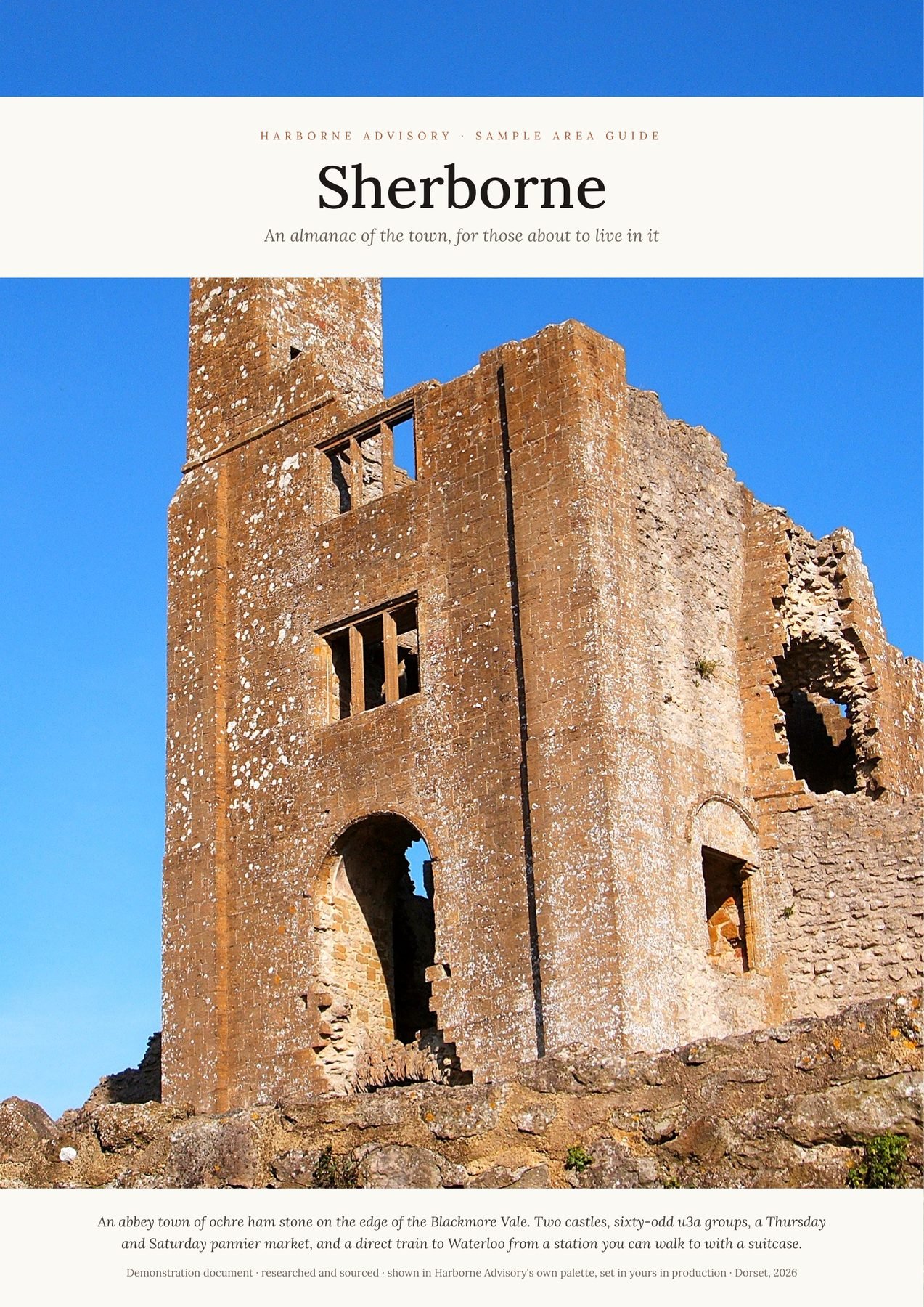
Sherborne, Dorset
A market town, buyers with time
At a glance
Getting about
Schools
Everyday essentials
Eating and drinking
Sport and recreation
Clubs and societies
Something for everyone
Outdoors and days out
A day out with the kids
The afternoon
An unhurried day out
The Sherborne year
Your first weekend
Walks from the door
The two castles
Sources
Leeds South Bank
A city district, buyers with a commute
At a glance
The commute
Getting about
The working neighbourhood
Day to day
After work
Sport and outside
Culture and what’s on
The green
A weekday, hour by hour
The rest of it
Thursday night
A Saturday
Who it suits
The Leeds year
The next five years
Sources
Three entries appear in both guides. Every other line exists in one and
not the other.
Sherborne has sixty u3a groups and an unhurried day out. Leeds has a rail matrix and a
Tuesday. Same method, same sourcing discipline, different document.
A day out trail
A day out, timed and costed.
Two pages in the middle of both samples. Four or five stops, the walk or drive between each
one, and what an afternoon actually costs.
Sherborne · a day out with the kids
Typical spendFree no charge£ under £10pp££ £10–25pp
1
Pannier Market
Thursdays and Saturdays the length of Cheap Street. Start here while everyone is fresh.
9.00 – 10.30Town car parksFree
3 min walk
2
Sherborne Abbey
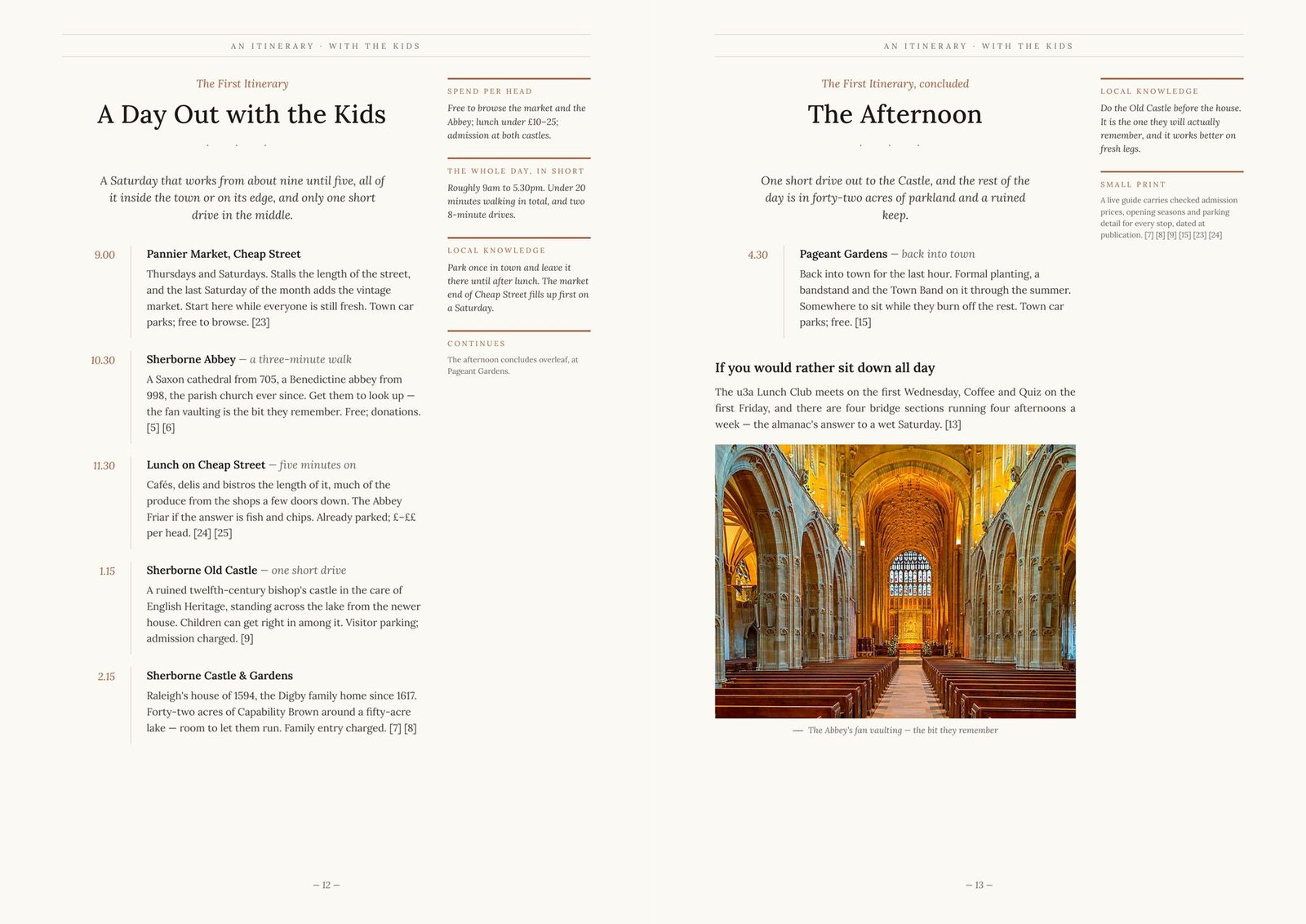
Saxon cathedral from 705. Get them to look up — the fan vaulting is the bit they remember.
10.30 – 11.30Walk from marketFree
5 min walk
3
Lunch on Cheap Street
Cafés, delis and bistros, much of the produce from the shops a few doors down.
11.30 – 12.45Already parked£–££
8 min drive
4
Sherborne Old Castle
A ruined twelfth-century bishop's castle. Children can get right in among it.
1.15 – 2.15Visitor parking£ admission
Timings are a suggested shape for the day, not a timetable. In a live guide every admission,
opening season and parking note is confirmed with the operator and dated at publication.
The pages viewers photograph.
Pricing
Published prices. Fixed fees.
Most agencies will not put a number on the page. Ours is here, and it is the number on the
invoice.
For a single development
The Standalone Guide
£2,000
Fixed fee · one site
16–20 pages, print and digital
Full local research and sourcing
Designed to your brand guidelines
Two rounds of amends
Print-ready PDF with bleed
Copyright assigned to you
For several sites
The Rollout Programme
£3,000
First site, including the format
Everything in the Standalone Guide
A reusable format built to your brand
£1,200 per site thereafter
Consistent across every development
You own the format outright
Annual re-verification, £250 a site
Add-on
Local photography
£450
Per site · half a day
High street, landmarks, green space, the walks
Licensed to you outright
No stock fees and no usage limits
Fixed fee, no hourly billing. The price on this page is the price on the invoice.
50% on commission, 50% on delivery. Four weeks from brief to print-ready artwork.
Copyright assigned in full on final payment. No licence terms attached.
No VAT is charged. The figures above are what you pay.
A guide that dates its claims needs a date service — we re-verify annually for £250 a site.
Build-to-rent: the same guide works as a letting tool — the area is what re-lets, and one guide serves every tenancy.
Agencies: white-label and subcontract terms available — ask.
Not ready to commission?
Start with a free check of what you hand out now.
Send us the area material your buyers are given today. We check every factual claim
against its current source and send back one page: what still stands, what has
moved, and what cannot be sourced at all.
No fee, no follow-up sequence, and the page is yours to keep whatever you decide.
Questions
The things worth asking first.
How long does it take?
Four weeks from brief to print-ready artwork, with both rounds of amends inside
that. The clock starts when the brief is agreed, not when the invoice clears.
Who owns the finished guide?
You do. Copyright is assigned in full on final payment, with no licence terms
attached — print it, host it, rework it, hand it to your agency.
What happens when it goes out of date?
Every claim in the guide carries a checked date, so staleness is visible rather
than silent. Annual re-verification is £250 a site: every source re-checked,
anything that moved corrected, and the artwork reissued.
Can we read a whole guide before we talk?
Yes. Both sample guides are on this page as full PDFs, Sherborne and Leeds South
Bank, with every source listed at the back. Read them the way a buyer would.
We already have area content. Is this for us?
Possibly more than anyone. Send it over and we will check each factual claim against
its current source, free, and return a single page showing what still holds. If it
all stands up, you have lost nothing.
What do you need from us?
Brand guidelines and a contact. That is the whole list — the research, the
writing, the sourcing and the design are the job you are paying for.
Work
Two sample towns, researched end to end.
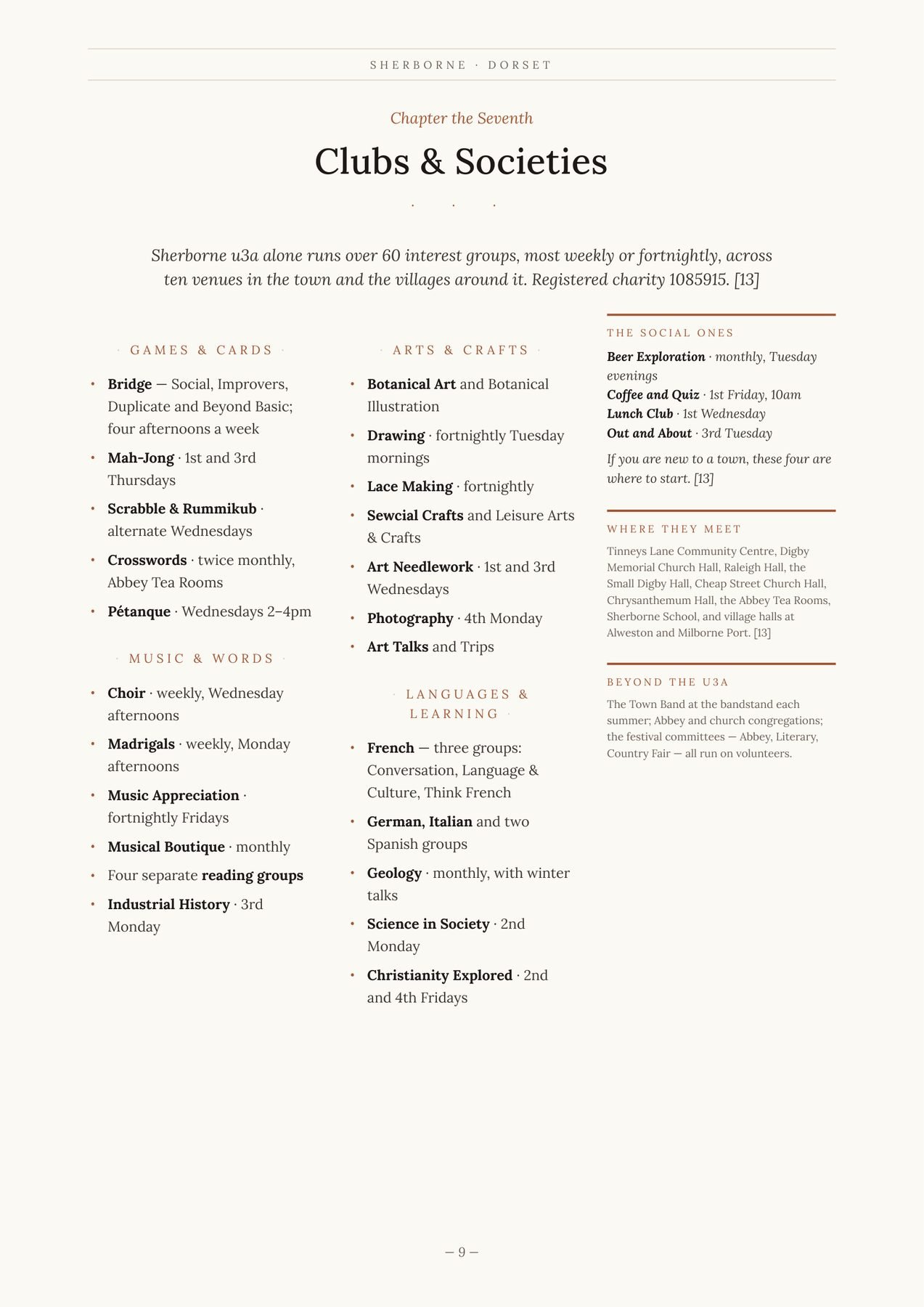
Sample area guide · clubs and societies
01 /
Sherborne, Dorset
Problem
A market town where the area sells the home as much as the home does, and
collateral that stops at a list of nearby schools.
Solution
A 20-page guide naming 60-plus u3a interest groups with their meeting days, the
Thursday and Saturday pannier market, every club at the Terrace Playing Fields,
and a two-page day-out trail with walking times and typical spend at each stop.
Twenty-eight sources
Sample area guide · the working neighbourhood
02 /
Leeds South Bank
Problem
A city-centre apartment district where the buyer is a commuting professional, and
collateral that sells the building without ever describing the week they would
actually live.
Solution
A 20-page guide built around a rail matrix from Leeds station, the hundred
companies on the mill estate next door, and two illustrated spreads: a weekday
hour by hour, and a Thursday night and Saturday that never leave the postcode.
The next five years, with each item’s actual status attached — built, committed, target date, proposed. Selling all four as the first is where area marketing goes wrong.
Twenty-nine sources
Sample pages
Look inside.
Two towns, two buyers, one method. Sherborne is a market town written for someone with
time; Leeds South Bank is a city district written for someone with a train to catch.
Sherborne, Dorset
Cover Page 1
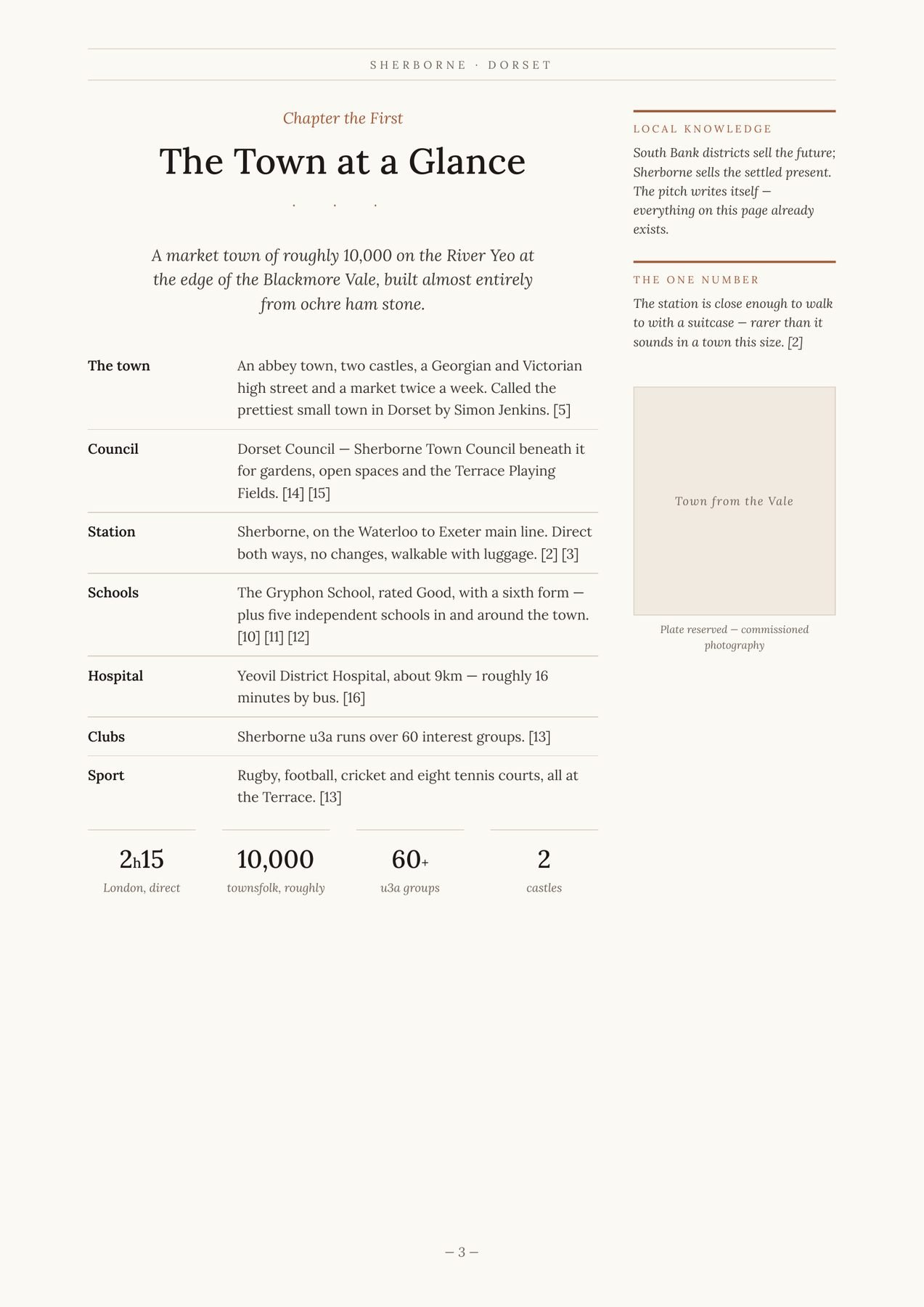
At a glance — the essentials on one page Page 3
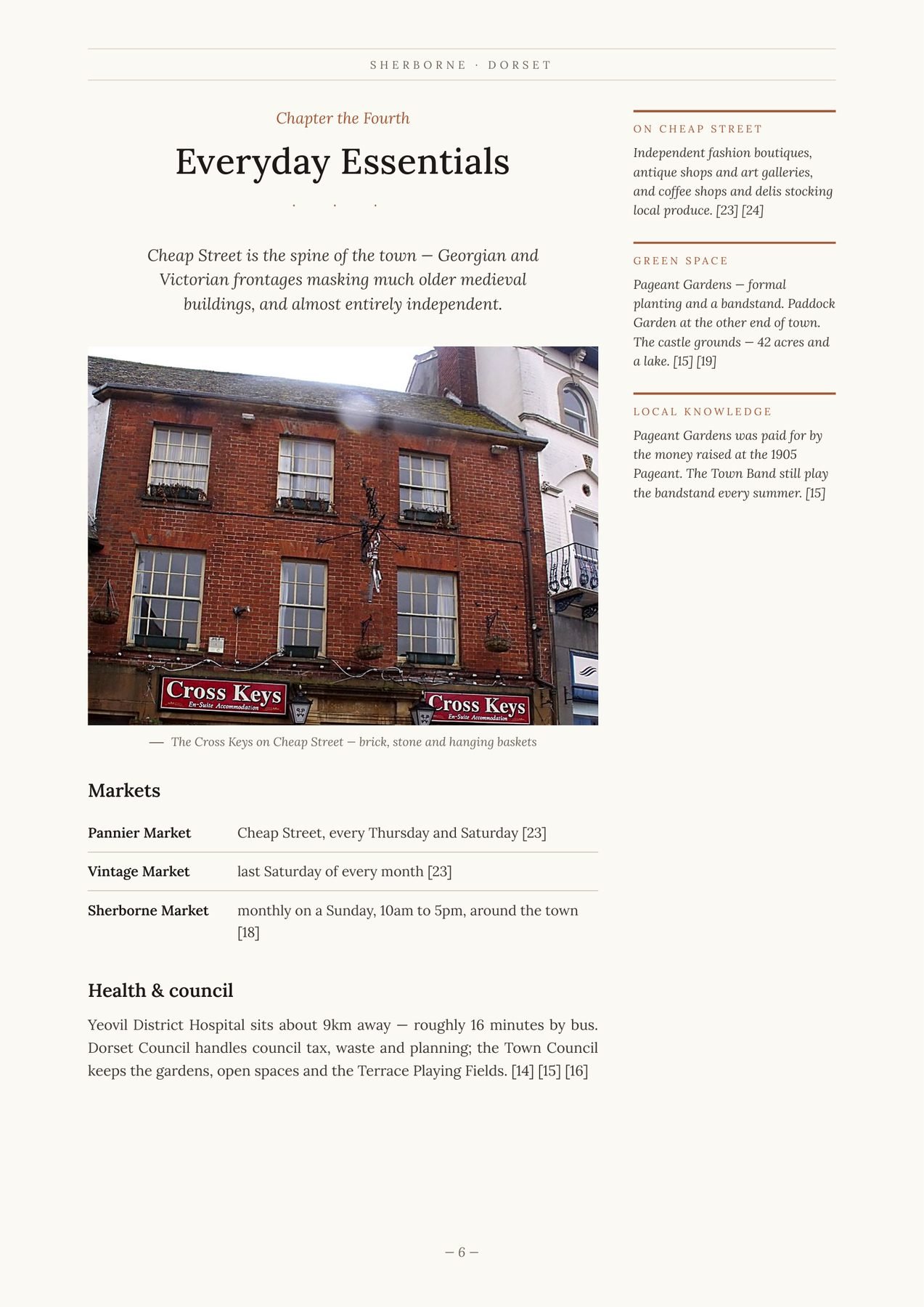
Everyday essentials — markets, health, the high street Page 6
Clubs and societies — 60-plus u3a groups with meeting days Page 9
A day out with the kids — the two-page trail Pages 12–13
Every guide is drawn to the client's brand, contents and audience — the typefaces, the
palette, the grid, the page shape and the running order all come out of the scoping
conversation. These are the same two towns, researched the same way, designed four
different ways. Nothing here was poured into a house style, because we do not have one
to pour it into.
Your brand
Typefaces, palette and logo, worked from your guidelines, not approximated.
Your contents
The running order comes from who buys on your site. A commuter district and a market town do not need the same chapters.
Your format
Portrait or landscape, print or PDF, desk-sized or pocket, whatever the sales office actually needs.
Your voice
The register is set in scoping and held to across every page.
Sherborne — the almanac current
Portrait, serif, marginalia and chapter openers. Built for a market town and a buyer with time.
Leeds — the board current
Landscape, amber on black, mono data bands. Built for a city district and a buyer with a commute.
Sherborne — the earlier direction earlier
The same research, laid out warm and landscape. A different answer to the same brief.
Leeds — the earlier direction earlier
Graphite and signal blue, card-led. Also ours, also the same town.
Only the design brief changed. All four are our own demonstration documents for two
sample towns, not client commissions.
First project
Let's find out if there's a guide worth building.
Pick one live site. £2,000 fixed, four weeks, and the guide is yours outright —
whether or not you ever commission a second.
No obligation. No lengthy sales presentation.
Or start smaller: send us your existing area material and we'll return a one-page
note listing what no longer holds. Free, no strings.
Usman Sharif, Customer Experience Manager, looks after every
client from scoping to delivery —
LinkedIn.
Harborne Advisory is run by Sami Chowdhury. The research is
done the way the samples suggest — from the sources, on the ground, and dated.